Over
years of
Connecticut
family law

Practicing since
Own firm since
Family law is
4.6 stars across
Help Through Life's Hardest
Challenges
Divorce, Custody, and Mediation Across Fairfield and New Haven Counties
Divorce is one of the hardest things most people go through, and almost nobody goes through it twice. What happens over the next several months will shape your finances, your relationship with your children, and how the next decade of your life looks. That is not a process to navigate alone or on advice from the internet.
Attorney James A. Cuddy has practiced Connecticut family law since 1997 and has run his own firm in Shelton since 2011. He handles divorce, child custody and visitation, child support, alimony, property division, and post-judgment modifications for clients throughout Fairfield and New Haven counties — including New Haven, Milford, Bridgeport, Stratford, and Waterbury.
Some of those cases settle at the table. Some of them are fought. He will tell you honestly which one yours is likely to be, and he will handle it either way.

Practice Areas

Divorce
Contested and uncontested dissolution across Fairfield and New Haven counties — property division, alimony, and the financial affidavit work that decides most of what you walk away with.

Child Custody & Visitation
Legal and physical custody, parenting plans, and post-judgment modifications, decided under the seventeen best-interest factors in Conn. Gen. Stat. § 46b-56(c).

Divorce Mediation
About a quarter of the firm's work. A structured alternative that costs less than litigation, stays private, and leaves the two of you in control of the outcome instead of a judge.

Family Law
Child support, alimony, paternity, relocation, prenuptial and postnuptial agreements, protective orders, same-sex divorce, and enforcement of out-of-state orders.
One Lawyer,
One Case
When you are facing a difficult legal situation, you need someone who listens and cares about what you are going through. Whether you are getting a divorce, have been in a car accident or need a simple will, you deserve a lawyer who will follow through with you every step of your case. Other firms may pass your case off to a junior associate or a rotating cast of legal assistants. That is not our style. At our firm, James Cuddy will personally handle your case from start to finish.
Why choose Us?
You Deal
With One Person.
Attorney Cuddy conducts your intake, runs your consultation, and works your file through to judgment. There is no associate, no rotating staff, and no point at which you get handed off to someone you have not met.
Staying
Informed.
Poor communication is the most common complaint clients have about attorneys anywhere. If Attorney Cuddy is in the office when you call, he takes the call. If he is in court, you get a callback — in nearly all cases the same day.
Direct.
Honest. Fair.
You will be told what you need to hear about your position, not what would be easier to hear. An honest read on your case in week one is worth more than an optimistic one you find out was wrong in month four.
Twenty-Nine Years, & Willing to Try It.
Attorney Cuddy has practiced Connecticut family law since 1997 and clerked at Bridgeport Superior Court before that. Many cases should settle, and he will tell you when yours is one of them. When a case needs to be tried, it gets tried.

About Attorney
James A. Cuddy
Before he opened his own practice, James Cuddy served as an assistant clerk to Justice Melville at Bridgeport Superior Court — a year spent watching, from the inside, how judges actually weigh the cases he now argues. He has practiced Connecticut family law since 1997 and has run his own firm in Shelton since 2011. Family law is roughly 98% of what he does.
- J.D., University of Connecticut School of Law Hartford, Connecticut.
- B.A., Kent State University, 1994 Criminal Justice. Dean's List; Golden Key National Honor Society.
- Admitted, Connecticut Bar, 1997 Active and in good standing.
- Admitted, U.S. Federal Courts, 2004
- Assistant Clerk, Bridgeport Superior Court, 1997–1998 Clerked for Justice Melville.
- Connecticut Bar Association Member since 1997.
- Milford Bar Association Member since 2011.
In Attorney Cuddy's Words
on honesty
"I tell you what you need to hear, not what you want to hear. I'm not going to promise you the sun, the moon, and the stars and then tell you four months later that it was never going to happen."
on the no-handoff promise
"You are not going to be passed off to an associate who has been practicing for two years. If you retain me, you retain me. I'm the one working your file."
on the mission
"I'm not a file churner. My job is to represent people with empathy, work diligently, and be a tough advocate for their interests."
What Happens When You Call

You call
203-513-8642.
If he is in court, you
get a callback.
He conducts your
consultation himself.
Your case is not passed to a junior associate.
Where We Practice
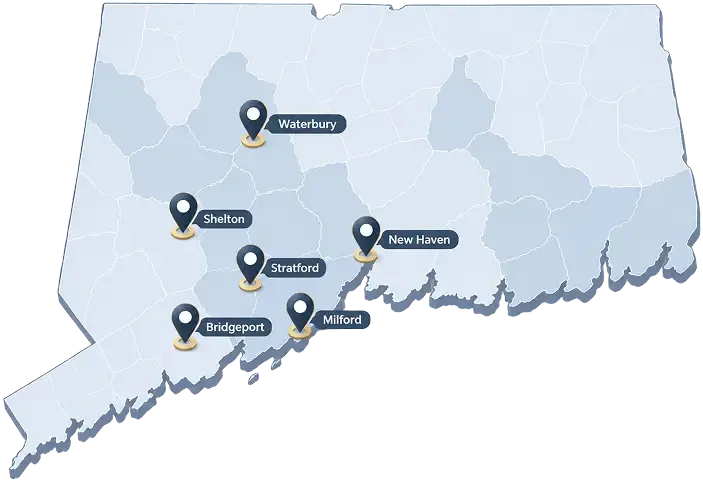
Shelton
Judicial District of Ansonia-Milford, courthouse in Milford. Our office is at 525 Bridgeport Avenue, Suite 201.
Milford
Judicial District of Ansonia-Milford — along with Ansonia, Beacon Falls, Derby, Orange, Oxford, Seymour, and West Haven.
Bridgeport
Judicial District of Bridgeport. This district was called the Judicial District of Fairfield until Public Act 23-46 renamed it effective January 1, 2024.
Stratford
Judicial District of Bridgeport, with Trumbull and Monroe.
New Haven
Judicial District of New Haven — with Hamden, North Haven, Branford, East Haven, Woodbridge, and Wallingford.
Waterbury
Judicial District of Waterbury — with Naugatuck, Middlebury, Prospect, Southbury, Watertown, Wolcott, and Woodbury.
What Our Clients Say
These are real reviews from former clients, published on Google.


Jim is always direct and honest and fair. You may not like what he says but listen to his words, for he tells you what you need to hear, not...
I had an abusive husband who was controlling and manipulative , he is a narcissist- would rather spend money on a private investigator than feed his kids . He went...
Going through a divorce is not easy. Finding a good lawyer is the best thing you can do. I found the best. Attorney James Cuddy is professional, friendly, open and...
Attorney Cuddy was very insightful and knowledgeable in helping me gain joint legal custody. I live outside the state of Connecticut. He made what may seem, a complex and somewhat...
It was truly a pleasure to have Attorney Cuddy as my representation for a Child Support Modification case. Attorney Cuddy’s experience and in-depth knowledge of the interpretation and application of...
I had the pleasure of having Attorney Cuddy represent me for 3 years. I was impressed on how professional, and dedicated he was with my case. He answerd all my...
I was truly blessed in having Attorney Cuddy helping through my divorce process. Going through a divorce was a very difficult time but he had greatly helped alleviate the process...
Attorney James Cuddy helped me to draft and finalize a prenuptial agreement with my fiancée. He was extremely professional, up-front about his hourly rate and anticipated billable hours, thorough, and...
Attorney Cuddy was wonderful in my divorce and child custody case. He was very kind and understanding, and it felt like he really was concerned for my family. He was...
Attorney Cuddy is a true professional in every sense of the word. My divorce as a whole was incredibly tiring and draining but Attorney Cuddy was efficient, responsive, and reactive....
If you are looking for an honest, real, caring person to represent you, Jim Cuddy is the man. His level of knowledge and experience is outstanding. His ability to navigate...
I greatly appreciate working with Attorney Cuddy throughout my long and contentious child custody and divorce process. In the latter part of it I felt like things weren’t going the...
Attorney Cuddy was an absolutely amazing attorney who litigated my divorce and the settlement was everything I had hoped for! I never could have made it through this tumultuous time...
Working with Attorney Cuddy was such a pleasure! He was patient, professional, honest and approachable throughout the entire experience. I wasn't sure what to expect when starting the divorce process,...
Attorney James Cuddy was amazing throughout the divorce process. He was professional, prompt, responsive, and truly compassionate. He expertly led me through the daunting process at a time of heightened...
Working with Attorney James, was a true blessing. His level of compassion and expertise are unmatched in handling family cases with care. I highly recommend this attorney, as he shows...
I was very satisfied and pleased with the services provided by Attorney James Cuddy. He consistently returned my calls and emails in a timely manner, and his work was incredibly...
Attorney James Cuddy is really professional in his work has experience. I did have another attorney I took had my case for 7 months an nothing as soon I contact...
A pleasure to work with lawyer James Cuddy. I was very well represented and supported throughout my trial. I was kept up to date on all aspects of my trial...
I highly recommend this attorney to anyone navigating a custody matter. From the very beginning, he was personable, professional, and incredibly easy to work with. He took the time to...
I unequivocally recommend Attorney James Cuddy to anyone who’s facing a divorce. I had just begun treatment for cancer at the same time that I also was facing what I...
Attorney Cuddy is an exceptional family lawyer who truly goes above and beyond for their clients. From the very beginning, he demonstrated professionalism, compassion, and a deep understanding of family...
Frequently Asked Questions
About Connecticut Family Law
Every statutory citation below was verified against the Connecticut General Statutes as of August 19, 2026.
Q. How do legal fees work?
Initial consultations are scheduled by phone, and Attorney Cuddy decides case by case whether an introductory call is the right fit before any fee is charged. Connecticut Rule of Professional Conduct 1.5(b) requires that the scope of representation and the basis or rate of the fee be communicated to the client in writing before, or within a reasonable time after, the representation begins — so you will always have the fee arrangement in writing. Note also that Connecticut prohibits contingency fees in family law: under Rule 1.5(d)(1), a lawyer may not charge a fee in a domestic relations matter that is contingent on securing a dissolution or on the amount of alimony, support, or property settlement.
Q. How long do I have to live in Connecticut before I can file for divorce?
You can file a divorce complaint in Connecticut at any time after either spouse has established residence here — but under Conn. Gen. Stat. § 46b-44(c), the court cannot enter a decree unless one of three things is true: (1) one spouse has been a Connecticut resident for at least the twelve months immediately before the complaint was filed or immediately before the decree; (2) one spouse was domiciled in Connecticut at the time of the marriage and returned intending to remain permanently before the complaint was filed; or (3) the cause of the breakdown arose after either party moved into Connecticut. Service members who were Connecticut residents when they entered the armed forces or merchant marine are treated as having continuously resided here during their service.
Q. How long does a divorce take in Connecticut?
Under Conn. Gen. Stat. § 46b-67(a), the court generally cannot act on a dissolution complaint until ninety days after the return day. That ninety-day period is the statutory floor, not the typical timeline — a contested divorce involving custody, a business, or disputed assets commonly runs well beyond it. The waiting period can be waived under § 46b-67(b) if both spouses attest under oath that they have reached a complete agreement on every term. Connecticut also offers a streamlined nonadversarial dissolution under § 46b-44a, but the eligibility rules are narrow: the marriage cannot exceed nine years, neither spouse may have children from the marriage, neither may be pregnant, neither may hold an interest in real property, the combined fair market value of all property less debt must be under $80,000, neither may have a defined benefit pension plan, and neither may have a pending bankruptcy petition.
Q. How do Connecticut courts decide child custody?
Connecticut courts decide custody and parenting time according to the best interests of the child under Conn. Gen. Stat. § 46b-56. Subsection (c) sets out seventeen factors a court may weigh, including the physical and emotional safety of the child, the temperament and developmental needs of the child, each parent's capacity and disposition to understand and meet those needs, the length of time the child has lived in a stable and satisfactory environment and the desirability of maintaining that continuity, and the mental and physical health of everyone involved. Two points surprise most parents: the statute expressly says the court is not required to assign any particular weight to any factor, and the court must articulate the basis for its decision. There is no formula and no automatic outcome — which is why how your case is presented matters.
Q. How is property divided in a Connecticut divorce?
Connecticut is an all-property equitable distribution state, and that makes it unusual. Under Conn. Gen. Stat. § 46b-81(a), the court may assign to either spouse "all or any part of the estate of the other spouse," and may pass title to real property or order it sold. Connecticut does not draw the marital-versus-separate property line that many states do — an inheritance, a premarital asset, or a gift can be reached by the court. Equitable does not mean equal. Section 46b-81(c) directs the court to consider the length of the marriage, the causes for the dissolution, and each spouse's age, health, station, occupation, income, earning capacity, vocational skills, education, employability, estate, liabilities, and needs, along with each party's opportunity for future acquisition of assets and each party's contribution to the acquisition, preservation, or appreciation in value of their respective estates.
Q. How is child support calculated in Connecticut, and what changed on August 1, 2026?
Connecticut child support is set by the state's Child Support and Arrearage Guidelines. Under Conn. Gen. Stat. § 46b-215b(a), the guideline figure carries a rebuttable presumption that it is the correct amount, and a court may deviate only by making a specific finding on the record — at a hearing or in a written decision — that applying the guidelines would be inequitable or inappropriate in that case. Substantially revised guidelines took effect August 1, 2026. The most significant change for higher-earning families is that the schedule now extends to $6,000 in combined net weekly income, up from $4,000 — roughly $312,000 a year instead of about $208,000 — so courts no longer have to extrapolate above the old ceiling in many professional-household cases. The 2026 revisions also added a worksheet for cases with more than two legally recognized parents, new criteria governing when a court may impute income to an underemployed parent under Conn. Agencies Regs. § 46b-215a-5c(c), and clarified treatment of Paid Family and Medical Leave contributions.
Q. When does child support end in Connecticut, and can a court order help with college?
Under Conn. Gen. Stat. § 46b-84(b), if an unmarried child of the marriage has turned eighteen and is still a full-time high school student, the parents must continue to maintain the child according to their respective abilities until the child completes twelfth grade or turns nineteen, whichever comes first. College is separate. Conn. Gen. Stat. § 46b-56c allows a court to enter an educational support order covering an undergraduate degree or vocational instruction, but it is bounded: no more than four full academic years, terminating no later than the child's twenty-third birthday, and capped at the amount The University of Connecticut charges a full-time in-state student at the time the child matriculates — unless the parents agree to exceed it. Before entering such an order the court must find as a matter of fact that it is more likely than not the parents would have provided that support had the family remained intact.
Q. Can I move out of state with my child after a Connecticut divorce?
Not without either the other parent's agreement or a court order. Under Conn. Gen. Stat. § 46b-56d, the parent seeking to relocate carries the burden of proving three things by a preponderance of the evidence: that the relocation is for a legitimate purpose, that the proposed location is reasonable in light of that purpose, and that the relocation is in the best interests of the child. The court then weighs five factors: each parent's reasons for seeking or opposing the move, the quality of the child's relationship with each parent, the impact on the quantity and quality of the child's future contact with the non-relocating parent, the degree to which the relocating parent's and the child's lives may be enhanced economically, emotionally, and educationally, and whether the relationship with the non-relocating parent can be preserved through a workable visitation arrangement.
Q. Which courthouse will my Connecticut family case be heard in?
Connecticut assigns family matters by judicial district under Conn. Gen. Stat. § 51-344, and the boundaries do not follow county lines. Shelton — along with Ansonia, Beacon Falls, Derby, Milford, Orange, Oxford, Seymour, and West Haven — sits in the Judicial District of Ansonia-Milford, which sits in Milford. Bridgeport, Stratford, Trumbull, and Monroe are in the Judicial District of Bridgeport; note that this district was called the Judicial District of Fairfield until Public Act 23-46 renamed it effective January 1, 2024, so older articles and filings still use the former name. New Haven, Hamden, North Haven, Branford, East Haven, Woodbridge, and Wallingford are in the Judicial District of New Haven. Waterbury, Naugatuck, Middlebury, Prospect, Southbury, Watertown, Wolcott, and Woodbury are in the Judicial District of Waterbury. Our Shelton office is within about twenty minutes of all four courthouses.
Q. What happens when I call the office?
Attorney Cuddy handles intake personally. If he is in the office when a new client calls, he takes the call himself. If he is in court or on trial, his paralegal takes your information and Attorney Cuddy calls you back — under nearly all circumstances the same day. He also conducts every initial consultation himself rather than routing it to staff. Communication is the single most common complaint clients have about attorneys, and same-day contact is a deliberate standard at this firm rather than an aspiration. If you retain the firm, Attorney Cuddy is the attorney who works your file from start to finish. Your case is not passed to a junior associate.

One Call Is All You Need
One call is all it takes to find out where you actually stand. Reach the office at 203-513-8642, or send a message and we will respond promptly. If getting to Shelton is difficult, ask — Attorney Cuddy accommodates schedules and can arrange to meet you.